
Every Indian home has the same end-of-day ritual for the person dealing with kabz. At 10 PM the small Sat-Isabgol box comes out of the kitchen shelf. Two flat spoons, half a glass of warm milk or water, drunk fast before it turns to jelly. The patient goes to bed hopeful. By morning, the bathroom visit is the same — slow, incomplete, that heavy not-quite-finished feeling that follows you through the day. “Pet saaf nahi hua.”

If this sounds like you, or your parent, or your spouse, this is for you. Isabgol isn’t the villain — it’s one of the better-evidenced fibres on the planet, derived from the husk of Plantago ovata, a plant native to the Indian subcontinent. But it’s being used in a way that, for a meaningful share of Indian users, actually makes the constipation worse. And in the rest of cases, the husk is patching over a deeper cause — usually a slow-acting thyroid, a magnesium-deficient diet, or a pelvic-floor coordination problem called dyssynergic defecation — that no amount of fibre on top can fix.
The trouble is that nobody investigates. Most people just keep doubling the dose.
The 17 percent number — and why most of it stays untreated
A community survey of 505 adults in Chandigarh applying Rome diagnostic criteria found chronic constipation in 16.8% of the population by Rome II, and self-reported constipation within the past year in 24.8%. [1] A later analysis of 925 Indian constipated patients found that 75.6% had functional constipation and 24.4% had IBS-C (constipation-predominant irritable bowel syndrome). [2] An Indian tertiary-care study using anorectal manometry and colonic transit testing classified pathophysiological patterns as 64% normal-transit constipation, 19.9% dyssynergic defecation, 14.3% slow-transit constipation, and 1.9% mixed. [3] In simple terms: roughly one in six Indians is regularly constipated, three-quarters of those cases are functional, and nearly a fifth of constipated patients have a coordination problem of the pelvic floor that no laxative will fix.
Almost none of these patients are formally evaluated. The Indian default is to reach for fibre, then for senna or bisacodyl from the chemist (Cremaffin Plus, Dulcolax, Pursena, Kayam Churna, Sofsena — the medicine-cabinet roll-call of every Indian household), then to accept the situation as “normal for me.” A surprising number end up on a stimulant laxative for years, which itself blunts the bowel’s natural rhythm.
Why your Isabgol may be making it worse

Isabgol — psyllium husk — is a soluble fibre that absorbs water and forms a gel. That gel adds bulk to stool, lubricates the bowel wall, and stimulates the natural urge to evacuate. When it works, it works because it has water to absorb.
The Indian failure pattern goes like this. The half-glass of warm milk or water is enough to swallow the husk down the throat. It’s nowhere near enough to hydrate the husk through the rest of its journey. Once the husk hits an already-dehydrated colon — and most Indian adults walk around mildly dehydrated, particularly office workers, particularly anyone over 50, and particularly anyone whose primary “fluid intake” is several cups of tea or coffee — it does the opposite of what you want. It draws what little water there is out of the stool, turning soft material into a harder mass. The morning struggle gets worse, not better.
You know that line on the back of the Isabgol pack about taking it with plenty of water? It exists for a reason. The Cleveland Clinic guidance is explicit: psyllium husk must be taken with at least 240–300 mL of water, and followed by a second glass of water within an hour. Indian instructions hint at this in small print. Nobody reads it. The “two spoons in warm milk before bed” routine that has become folk medicine is, for a meaningful number of users, the exact wrong protocol.
The honest fix to this part: if you use isabgol, drink it as a full glass (250 mL of water — not milk, which slows things further), drink another full glass of water within the next hour, and aim for 2 to 2.5 litres of total water intake during the day. If you can’t or won’t drink that much water, isabgol is the wrong fibre for you — switch to a stool softener like lactulose or PEG 3350 (Movicol, Macrogol) that pulls water into the bowel osmotically instead of needing it from you.
The real causes behind constipation that won’t quit — and they aren’t fibre
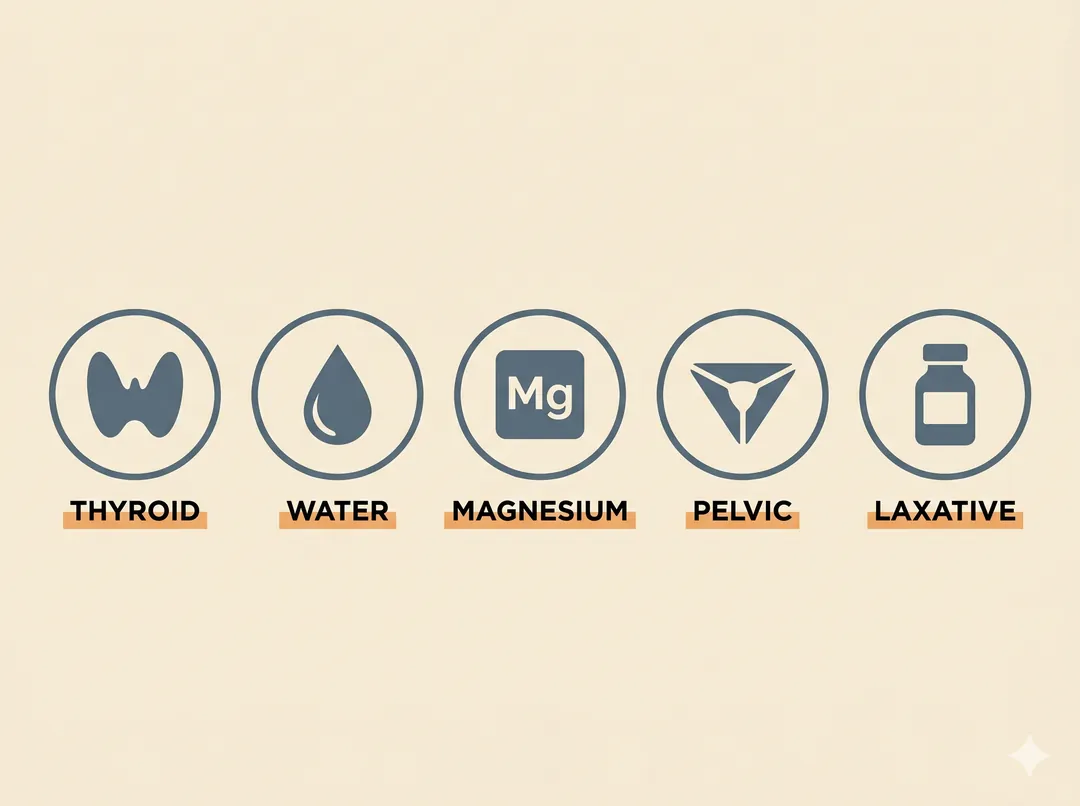
Once the isabgol-plus-water arithmetic is fixed, the patient who still has chronic constipation almost always has one of five drivers underneath, and none of them respond to more fibre piled on top.
Driver one — hypothyroidism. The single most under-diagnosed cause of stubborn Indian constipation. Thyroid hormone directly controls the rate of bowel smooth-muscle contraction. When thyroid is sluggish, the entire bowel slows — food sits in the colon longer, water gets reabsorbed out of it for longer, and what arrives at the rectum is harder than it should be. A 2024 Cureus review confirmed constipation as one of the most common GI manifestations of hypothyroidism and emphasised that treating the thyroid usually resolves the constipation. [4] Indian adult hypothyroidism prevalence is roughly 11% overall and ~16% in urban women. A simple TSH test (₹250–₹500) closes the question. If TSH is above 4 and especially above 6, your gut won’t move properly no matter how much spinach you eat.
Driver two — dehydration as a stable state. Many Indian adults drink less than a litre of plain water a day. Tea and coffee, while net-neutral on hydration over the day, don’t count as primary hydration in the timeframe they matter. Carbonated soft drinks worsen the picture. The colon’s job is to recover water from the slurry it receives; if the body is chronically short of water, the colon will keep extracting more, leaving harder stool. No amount of fibre fixes water deficiency. The 2–2.5 litre/day target for sedentary adults — more in summer, more for anyone doing manual work — is non-negotiable for this pattern.
Driver three — magnesium deficiency. This is the one almost no Indian GP investigates. Magnesium relaxes intestinal smooth muscle and draws water osmotically into the lumen, both of which soften stool and promote forward movement. Indian soils have been progressively depleted of magnesium by decades of chemical-fertiliser use, and Indian vegetarian diets are widely magnesium-deficient — particularly in adults who don’t eat nuts, seeds, whole grains, palak and leafy greens regularly. A 6–8 week trial of magnesium citrate or magnesium oxide 200–400 mg at bedtime, or magnesium glycinate for those who find the cheaper salts unpleasant, is one of the most effective and under-used Indian constipation interventions. Reduce or stop if loose stools result.
Driver four — dyssynergic defecation (anorectal coordination disorder). The under-recognised structural cause. Almost 20% of Indian constipated patients evaluated with manometry have it. [3] The mechanism: when you bear down to pass stool, the pelvic-floor muscles and the external anal sphincter should relax to let stool exit. In dyssynergic defecation, they paradoxically contract instead — closing the exit while the patient strains. The result is incomplete emptying, the “I sat for 20 minutes and barely passed anything” feeling, frequent straining, and the development of haemorrhoids and anal fissures from chronic straining. No amount of fibre, water or laxative fixes coordination. Anorectal biofeedback therapy is the evidence-based treatment — 4–6 sessions of physiotherapist-guided pelvic-floor retraining with pressure or EMG feedback. Long-term randomised trials show biofeedback restores normal function in dyssynergia patients more reliably than standard laxative therapy, with benefits maintained beyond two years. [5] Available at major Indian gastro centres and physiotherapy departments at ₹1,500–₹3,000 per session.
Driver five — laxative dependence. A pattern Indian medical schools used to warn about that the chemist counter has industrialised. Stimulant laxatives — senna (Cremaffin Plus, Sofsena, Pursena, Ayurvedic combinations like Kayam Churna and Triphala Churna at heavy doses), bisacodyl (Dulcolax) and castor oil — work by directly stimulating bowel contractions. Used short-term for a few days, they’re useful. Used daily for months or years, they desensitise the bowel — the colon stops contracting on its own and begins to require the stimulant to move at all. This is one reason the patient who first reached for Cremaffin five years ago “for one week” is now physically unable to pass stool without it.
The five-test panel for stubborn constipation
Before another month of guessing, ask your physician for these five tests. The total cost across most Indian metros is under ₹2,500.
TSH and free T4. The thyroid screen. If TSH is above 4, your gut is paying the price.
Serum calcium and serum magnesium. Two of the most relevant electrolytes for gut motility. Most Indian labs run them as part of a basic electrolyte panel.
Serum vitamin B12 and 25-OH vitamin D. Deficiencies in either can independently impair gut motility, particularly in older adults.
HbA1c. Long-standing diabetes can cause autonomic neuropathy of the bowel, presenting as chronic constipation. Worth screening, particularly over 40 with family history.
Complete blood count and ferritin in women, particularly if hair fall or fatigue is part of the picture (iron deficiency itself causes constipation in many women).
If after a thorough workup symptoms persist with weight loss, blood in stool, or new-onset constipation in someone over 50, a colonoscopy is the next correct step. Indian colorectal cancer incidence is rising in urban populations; “just constipation” isn’t always just constipation in the 50+ age group. If colonoscopy is normal and constipation is severe and refractory, gastroenterology evaluation with anorectal manometry, balloon expulsion test and colonic transit study will distinguish slow-transit constipation, dyssynergic defecation and normal-transit constipation — the three patterns need three different treatment approaches.
The protocol that actually works — in order

Step one — hydrate first, fibre second. Two to two-and-a-half litres of plain water a day for two weeks before changing anything else. Add a glass of warm water with a squeeze of lemon on waking — the gastrocolic reflex is strongest in the first hour after waking. This step alone resolves a meaningful share of chronic Indian constipation.
Step two — get the five-test panel done and treat what you find. If thyroid, take levothyroxine on the correct schedule (timing rules around calcium, iron, soya and tea make the medicine actually work). If B12 or vitamin D is low, correct it.
Step three — fix the fibre, don’t just increase it. Aim for 25–35 grams of mixed fibre per day from food first — soaked overnight oats, ragi porridge, palak, beans, sprouted moong, methi, lauki, papaya, prunes, soaked figs (anjeer), guava, jamun in season. If you supplement, isabgol with adequate water (250 mL with the dose, another 250 mL within the hour, total 2 L/day) or a combined soluble-and-insoluble fibre supplement. For IBS-C patients, soluble fibre alone is gentler; insoluble fibre (wheat bran, whole-wheat chokar) can worsen bloating.
Step four — magnesium at night. Magnesium citrate, oxide or glycinate 200–400 mg at bedtime for 6–8 weeks. Cheapest option is magnesium oxide; glycinate is gentlest if oxide upsets the stomach. Reduce or stop if loose stools result. Magnesium is also a sleep-supportive nutrient.
Step five — rebuild the bowel reflex. The bowel responds to predictable timing. Sit on the toilet at the same time every morning (typically 15–30 minutes after a warm drink and breakfast) whether or not the urge is present. Use a small footstool to elevate the knees above the hips — this approximates the Indian squatting position, which mechanically aligns the rectum for easier emptying. Five to ten minutes, no phone, no straining. The bowel relearns the rhythm in three to four weeks.
Step six — osmotic laxative (non-stimulant) for those who need help during the rebuild. Polyethylene glycol 3350 (PEG; Macrogol, Movicol) 17 grams in 250 mL water daily, or lactulose 15–30 mL daily. Non-habit-forming, gentle, evidence-based, and the preferred class for chronic use. PEG has stronger and more consistent efficacy data than lactulose in head-to-head trials. Available across India for ₹150–₹400 per pack.
Step seven — taper off any stimulant laxative gradually. If you’ve been on Cremaffin Plus, senna or bisacodyl daily for more than a few months, don’t stop abruptly — taper over 4–8 weeks while the magnesium, PEG and fibre take over. Expect a difficult first week or two. The bowel needs time to relearn how to contract without external prompting.
Step eight — prucalopride or other prokinetic for refractory cases. Prucalopride (Resotrans, Resolor) is a selective 5-HT4 receptor agonist that stimulates colonic motility. NICE recommends prucalopride after two laxatives from different classes have failed at the highest tolerated dose for 6 months. [6] Adult Indian dose is 2 mg once daily (1 mg in older adults or renal impairment). Number-needed-to-treat (NNT) of around 8.8 for the primary efficacy endpoint in pivotal trials. Available in India at ₹900–₹1,500 per month. Specialist-initiated for chronic refractory constipation. Other newer agents (linaclotide, plecanatide) are less widely available in India but emerging.
Step nine — biofeedback therapy if dyssynergic defecation is identified. This is the missing step in Indian outpatient practice. If anorectal manometry shows a coordination problem, refer to a physiotherapist or gastroenterology-physio team experienced in pelvic-floor retraining. Four to six sessions over 4–8 weeks; benefits durable for years.
For high-quality magnesium glycinate, magnesium citrate, lactulose, polyethylene glycol 3350 (PEG/Macrogol), prucalopride, levothyroxine, methylcobalamin and broader gastroenterology and nutraceutical lines at distributor pricing, our PCD pharma portfolio lists what we manufacture, and pharmacy owners and clinicians exploring distribution partnerships in GI and metabolic products are welcome to reach out.
When constipation is a red flag

For most adults, never. The following patterns warrant physician evaluation rather than another fibre supplement:
New-onset constipation in anyone over 50. Blood in the stool — red, dark or tarry. Unintentional weight loss alongside constipation. Persistent abdominal pain or a mass that can be felt. Severe straining with rectal pressure, prolapse or thunderclap rectal pain. Complete inability to pass stool and gas (bowel obstruction — same-day care). A sudden change in bowel habit lasting more than 2 weeks. Family history of colorectal cancer with new bowel symptoms. Severe constipation in a woman of reproductive age with cyclical pelvic pain (rule out endometriosis).
These can be signs of bowel obstruction, colorectal cancer, severe hypothyroidism, endometriosis with bowel involvement or other conditions that need imaging and colonoscopy. The medicine-as-last-resort framing applies, but red flags should never be normalised away.
The 10 PM Sat-Isabgol routine isn’t wrong because of the husk. It’s wrong because of the water that wasn’t drunk, the thyroid that wasn’t checked, the magnesium that’s been missing for years. Fix those, and the box on the kitchen shelf becomes a tool again, not a hope.
Disclaimer
This article is for general health information for adult Indian readers and does not replace medical advice. Chronic constipation, particularly with red-flag features described above, must be evaluated by a qualified physician. Do not begin high-dose magnesium, lactulose, PEG, prucalopride or stop a long-running laxative or thyroid medication without physician supervision, particularly if you have kidney disease, heart disease, or are pregnant or breastfeeding. Anorectal biofeedback should be performed by a trained physiotherapist or gastroenterology team.
Sources
1. Prevalence of constipation among the general population — a community-based survey from India. Tropical Gastroenterology, 2014. PubMed 25461464 2. Ghoshal UC. Chronic constipation in Rome IV era — The Indian Perspective. Indian Journal of Gastroenterology, 2017. PubMed 28643273 3. Study of Types of Pathophysiologic Patterns of Chronic Constipation and Its Correlation With Clinical Features. PMC, 2024. PMC12541276; Indian consensus on chronic constipation in adults — joint statement IMFDA and ISG. PMC. PMC6339668 4. Integrated Management of Constipation in Hypothyroidism — Evaluating Pharmacological and Non-Pharmacological Interventions. Cureus, 2024. PMC12566795 5. Long-term efficacy of biofeedback therapy for dyssynergia — RCT; Biofeedback efficacy for outlet dysfunction constipation — clinical outcomes and predictors of response. PMC, 2014, 2024. PMC3910270; PMC11650404 6. Prucalopride for the treatment of chronic constipation in women — NICE technology appraisal TA211; Efficacy and Safety of Prucalopride in Chronic Constipation — integrated analysis of six RCTs. PMC, 2016. NICE TA211; PMC4943977 7. Chronic Constipation — Is a Nutritional Approach Reasonable? Nutrients, 2021. PMC8538724
You might also like

Monobenzone Reviews — What Real Patients Say About Treatment
Monobenzone Reviews — What Real Patients Say About Treatment A note on this article. This is a synthesis…
Read article →
Depigmentation vs Repigmentation for Vitiligo — Which Approach Fits You?
Depigmentation vs Repigmentation for Vitiligo — Which Approach Fits You? The two strategies pull in opposite directions: bring…
Read article →
Talking to Your Dermatologist About Depigmentation — Questions to Ask
Talking to Your Dermatologist About Depigmentation — Questions to Ask Depigmentation therapy is a serious, permanent treatment. The…
Read article →