
What if the medicine itself is the reason your acidity won’t go away? It’s an awkward question, and there’s no clean answer in two lines.
Take Suresh. He’s 52, works at a private bank in Indore, and has been swallowing one Pan-40 every morning before chai for almost five years now. He started it after a general practitioner (GP) told him it was for “gas problem” during a busy stretch in 2021. The first three weeks felt almost magical: the burning behind the breastbone disappeared, the morning sourness was gone, the paratha-and-pickle lunch went down without complaint. He kept renewing the strip at the chemist below his flat. The chemist doesn’t ask for a prescription any more. Twice in the last two years he has tried to stop, and both times the burning came back within four days, worse than before. His doctor’s reply was the standard one: “Aapko jeevan bhar lena padega.”
The conventional view here is reasonable on its face. Pantoprazole works. It controls acid. If symptoms come back when you stop it, the diagnosis must be a chronic acid problem. Take it for life. That’s the model. And for a small minority of patients, with confirmed erosive disease or Barrett’s, it’s the right model.
Then the question gets uncomfortable. What if the rebound burning isn’t proof you need the pill? What if it’s evidence the pill itself created the demand for the pill?
If that’s you (or your father, or your boss, or the colleague who carries Pan-40 in his laptop bag), what you have isn’t acidity. What you have is a medication that has quietly made itself necessary, while the original problem either was never what you thought it was, or has drifted into something the tablet was never designed to fix.
This article is for the millions of urban Indians on long-term proton pump inhibitors (PPIs) who keep wondering why a “five-day course” turned into five years.
What the daily Pan-40 is actually doing
Pantoprazole, esomeprazole, rabeprazole, omeprazole — the PPI family. They work by shutting down the proton pumps in your stomach lining that make hydrochloric acid. The drop is dramatic; a 40 mg pantoprazole dose can cut acid output by 80–95 percent for nearly 24 hours. For an acute gastric ulcer, H. pylori eradication, or severe erosive esophagitis, this is genuinely life-saving medicine.
So far so good. The trouble starts when the tap stays turned off for years.
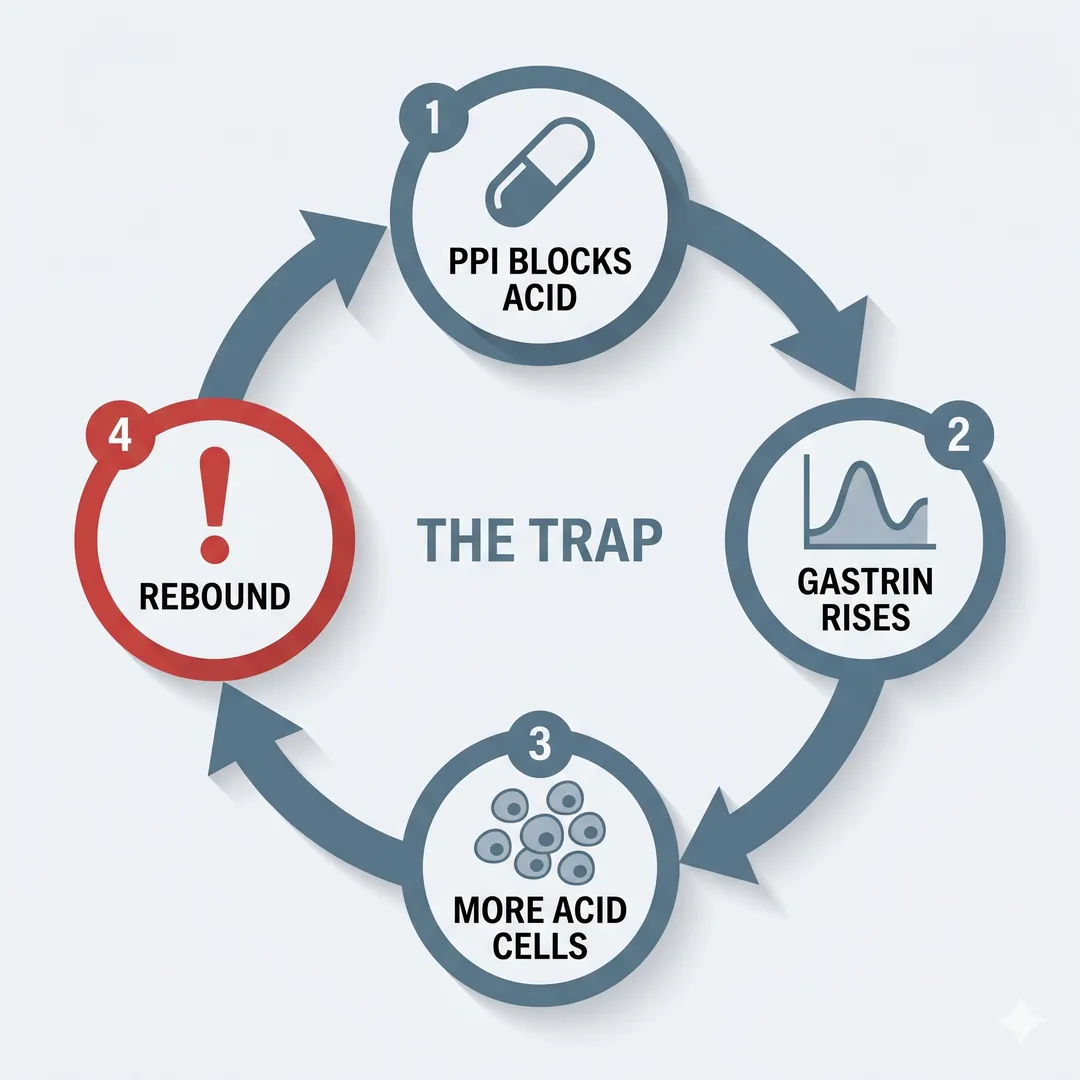
Your body notices the missing acid. It senses the alkaline stomach and starts producing more gastrin, the hormone that tells acid-producing cells to multiply. Over months you grow more of those cells than you started with. The day you finally try to stop the tablet, those extra cells start pumping out acid at a level your stomach has never seen.
This is called rebound acid hypersecretion. The landmark Reimer study (a randomised, double-blind, placebo-controlled trial in 120 healthy volunteers published in Gastroenterology in 2009) gave us numbers that probably belong on every PPI prescription pad. Volunteers who had never experienced acidity were given 8 weeks of esomeprazole 40 mg, then placebo for 4 weeks. 44 percent (26 of 59) developed acid-related symptoms in weeks 9 to 12, compared with 15 percent in the placebo group. The proportion reporting dyspepsia, heartburn or acid regurgitation in the PPI group was 22 percent in week 10, 22 percent in week 11, and 21 percent in week 12, compared with 7 percent, 5 percent and 2 percent in the placebo group. [1] The longer you’ve been on the tablet, the worse the rebound.
This is the trap. You experience the rebound as “see, I told you, my acidity is real — I need this medicine.” You restart Pan-40 and feel better in two days. The cycle continues. Nobody (not the chemist, not the GP who first wrote it, not the gastroenterologist who saw you for ten minutes) explains that the burning you felt on day three of trying to stop was the medicine doing it, not the disease.
There’s more. Pantoprazole has the highest reported incidence of hypomagnesemia among PPIs. The FDA issued a specific safety communication warning that prescription PPIs taken for longer than a year can cause dangerously low magnesium levels. Long-term PPI use is also linked to reduced absorption of vitamin B12, iron, calcium and magnesium, increased fracture risk (particularly hip, wrist and spine in older adults), increased risk of C. difficile and other gut infections from the loss of the acid barrier, and in observational studies a 10 to 50 percent higher risk of chronic kidney disease compared with non-users. [2,3] Some of these associations are still being argued about for causality. They’re not internet scare-stories, though. They’re FDA and NHS-acknowledged long-term effects of a drug that was never built for indefinite use.
The 2022 American Gastroenterological Association (AGA) expert review on PPI deprescribing is blunt about the broader pattern. Most patients on long-term PPIs do not have an indication that justifies it. All patients on a PPI should have a regular review of the ongoing indication (the responsibility of their primary care clinician, not the chemist). Patients without a definitive indication should be considered for a trial of deprescribing. Those on twice-daily dosing should usually be stepped down to once daily. [4]
The four real causes of “acidity that won’t go away” in India
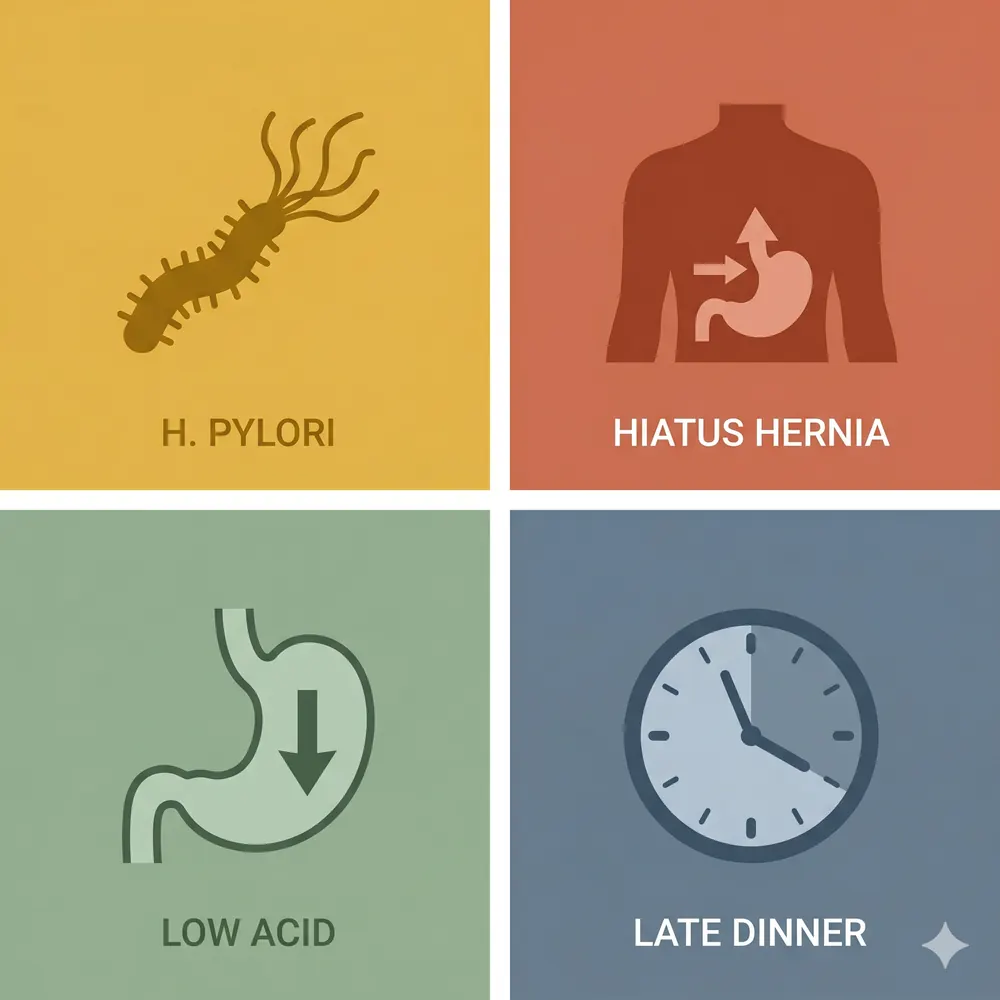
If Pan-40 isn’t the answer, what’s the question? In Indian patients, four causes account for the overwhelming majority of stubborn upper-gut symptoms. Only one of them is meaningfully helped by a PPI.
**Cause one: Helicobacter pylori.** This is the big one Indian medicine systematically under-tests for. H. pylori is a spiral bacterium that colonises the stomach lining. It causes most gastric ulcers, most duodenal ulcers, and a large share of “non-ulcer dyspepsia.”
Indian prevalence estimates from peer-reviewed reviews sit between 60 and 80 percent of the general population, with prevalence in patients presenting with dyspepsia at roughly 65 to 75 percent. [5] In a country where two-thirds of adults are carrying this bacterium and where the GP’s reflex for any burning or heaviness is to write pantoprazole, you can see the size of the missed diagnosis.
The test is cheap and non-invasive. A stool antigen test or a urea breath test, both available across India for under ₹1,500. The treatment is a 14-day quadruple therapy (a PPI plus three antibiotics — typically a combination of amoxicillin, clarithromycin, metronidazole, or tetracycline + bismuth, chosen based on local resistance patterns) rather than the older 7 or 10-day triple regimen. The Indian Society of Gastroenterology recommends at least 14-day regimens because shorter courses have lower eradication rates given Indian antibiotic resistance. A 2024 systematic review of Indian primary resistance found metronidazole resistance 77.65 percent, clarithromycin 35.64 percent, amoxicillin 37.78 percent, levofloxacin 32.8 percent. [5,6] South India, Gujarat and Kashmir have particularly high clarithromycin resistance, which means the once-standard “amoxicillin + clarithromycin + PPI” Indian regimen has lower eradication rates than a decade ago and needs to be tailored.
People who’ve been on Pan-40 for years often discover, when finally tested, that the real problem was H. pylori all along. Clear it, and the symptoms vanish. The PPI is no longer needed.
Cause two: hiatus hernia driven by central obesity. This is mechanical, not chemical. The diaphragm has an opening through which the food pipe passes into the stomach. When abdominal fat — the visceral, internal kind that wraps around the organs — pushes pressure upward, the top of the stomach can slide up through this opening into the chest. The valve at the bottom of the food pipe (the lower esophageal sphincter, or LES) loses its anchor and stops sealing properly. Acid that should stay in the stomach splashes upward, especially when you lie down.
No amount of acid-blocking will fix the mechanics. The fix is losing belly fat — the same fat that drives the fatty liver and metabolic syndrome cluster Indian adults are walking around with after age 35. Hiatal hernia is also the most common reason that “PPI-refractory GERD” turns out to be perfectly normal GERD failing to respond because the underlying anatomy was never addressed.
Cause three: low stomach acid being mistaken for high stomach acid. This is the counterintuitive one. Most Indian doctors don’t even discuss it. The symptoms of too little acid (bloating after meals, fullness, gas, a heavy feeling that travels up to the throat as the meal sits there undigested) overlap almost completely with what patients describe as “acidity.”
Years of PPI use can produce exactly this state. Food sits, ferments, produces gas, the gas pushes upward, and the patient interprets the burning as “more acid” and reaches for another Pan-40. Cleveland Clinic and multiple gastroenterology references now flag explicitly that hypochlorhydria is widely under-recognised and frequently misdiagnosed as GERD. The diagnostic tell: symptoms get worse with a protein-heavy meal (which needs acid to digest) and better with a tablespoon of apple cider vinegar in water before food (which transiently raises acid). Try it once. The pattern is often clarifying.
Cause four: the Indian dinner clock. Most urban Indian families eat between 9 and 10:30 pm. Many sleep by 11:30 pm. That’s a 60 to 90 minute gap between a heavy meal and lying flat. Gravity is the LES valve’s silent helper. Lie down too soon and acid travels up the food pipe no matter how well the valve is working. A community-based Indian study found GERD significantly associated with a dinner-to-bedtime interval of ≤2 hours. Combine a late dinner with a fried sabzi, a glass of milk taken “for acidity,” and a paan or a sweet to finish, and you’ve engineered the perfect reflux event. No amount of pantoprazole can outwork dinner at 10 pm.
At first I thought the cause-three case for low stomach acid was overstated. The bigger Indian data clearly point at H. pylori and dinner timing as the dominant drivers. But then you look at the long-term PPI cohort specifically, and the picture shifts. Years of suppressed acid produce hypochlorhydria in a meaningful fraction of patients. The symptom overlap with classical reflux is real. So I changed my mind — it deserves a seat at the table, just not the head of it.
What real Indian patients are quietly saying
Scroll through any Indian patient forum (Practo, Apollo 24/7, the Quora India digestive-health threads) and the same sentence shows up in slightly different words: “On Pan-40 for two years, every time I stop the burning comes back in 3 days, doctor only says continue, I am scared of long-term use but what to do.”
Tens of thousands of versions of this question exist online. The answer almost nobody has given them is that the burning on day three is the rebound, not the original disease. There’s a way out. Just not a fast one.
On the pharma distribution side, the pantoprazole 40 mg strip is one of the highest-volume single SKUs (stock keeping units) in any Indian retail pharmacy basket. The reorder cycle is monthly, usually customer-initiated, often without a fresh consultation. That market reality is itself a kind of evidence for how the drug is being used.
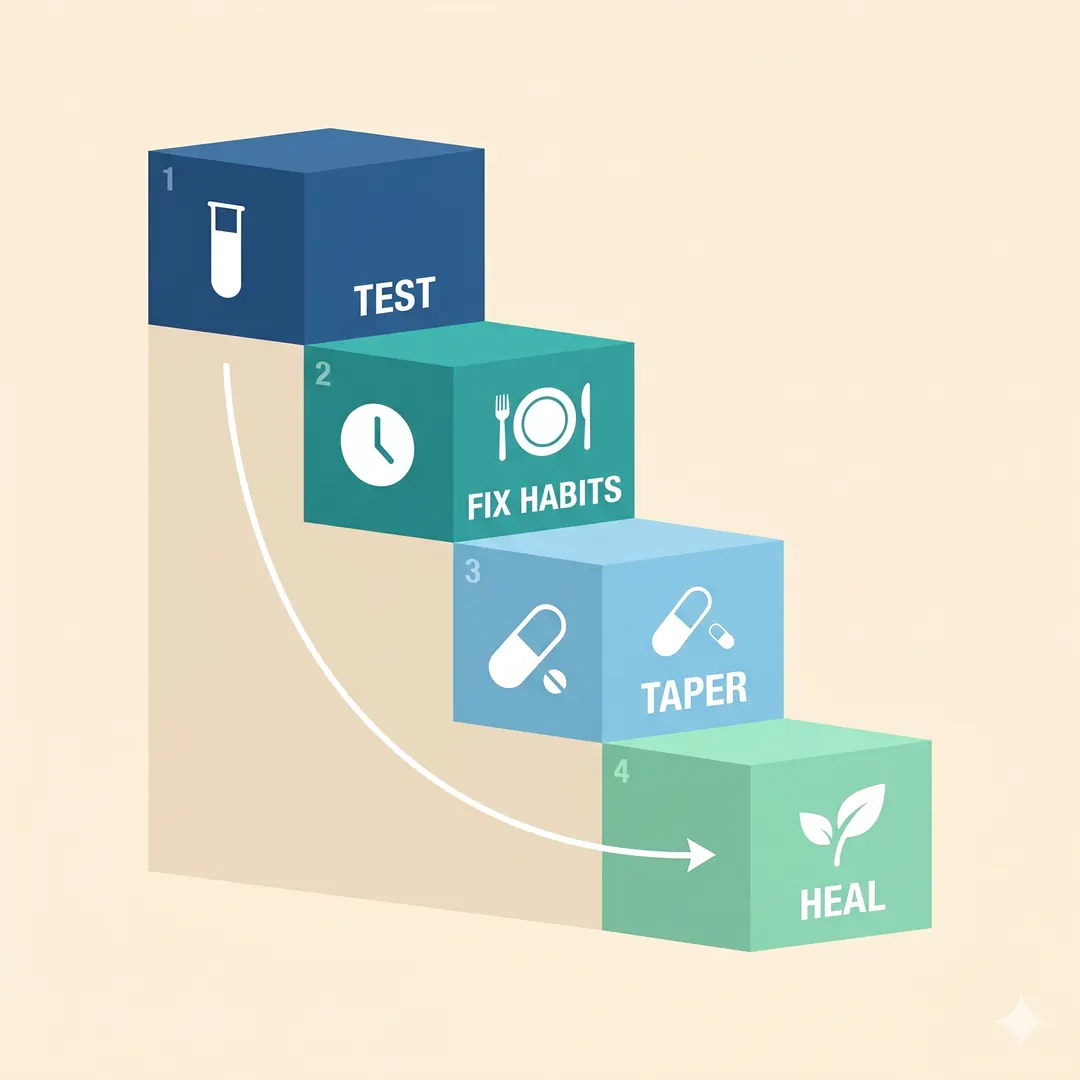
The protocol for getting off Pan-40 — in order
This isn’t a “stop tomorrow” plan. The rebound is real. Done carelessly, you’ll feel awful for a week and crawl back to the tablet. Done properly, the same exit takes six to ten weeks and sticks.
**Step one — get tested for H. pylori, finally.** Stool antigen or urea breath test. No fasting needed for the stool. Light fasting for the breath test. The PPI itself can suppress H. pylori and produce a false-negative result, so the test ideally needs the PPI stopped 2 weeks before testing, with H2 blockers (famotidine) and antacids as bridge. If positive, do the full 14-day regimen your physician prescribes, chosen based on regional resistance. Don’t skip a single dose; resistance is a real problem. After completion, retest 4 weeks later, again off PPI. Many people find their “permanent acidity” resolves with this single step.
Step two — fix the four habits before tapering. Move dinner to 7:30–8 pm, no later. Walk 20 minutes after dinner (a short stroll, not a workout). Sleep with the head end of the bed raised 6 inches (a foam wedge or wooden blocks under the head-end legs, not just stacked pillows under the neck. Pillows bend the spine, not the gastric junction). Lose 4 to 6 kilos if your waist is more than 90 cm for men or 80 cm for women. These four habits alone reduce reflux symptoms in the majority of patients without any medication change.
Step three — taper the PPI, do not stop it abruptly. The standard deprescribing approach: 40 mg daily for one week, then 40 mg alternate days for two weeks, then 20 mg alternate days for two weeks, then stop, with an antacid (Gaviscon, Digene) or H2 blocker (famotidine 20 mg) on standby for breakthrough symptoms. [4] Expect mild rebound for 5 to 14 days. It will pass.
The alginate-based Gaviscon (which physically floats on top of stomach contents and blocks reflux mechanically rather than chemically) is the under-used hero of this phase. Famotidine at bedtime can cover the trough for the first 2 weeks.
For patients who genuinely need ongoing acid suppression but want to minimise daily PPI use, “on-demand” PPI dosing (take only when symptomatic) or step-down to H2 blockers is supported by the AGA expert review for patients without erosive disease or Barrett’s.
Step four — heal the gut you just had on standby. A short course of a probiotic (saccharomyces boulardii or a multi-strain lactobacillus blend), magnesium glycinate at bedtime if you were on long-term pantoprazole (it’s the most magnesium-depleting PPI), and a B-complex with B12 for three months covers the deficiencies most long-term PPI users have quietly accumulated. Check serum B12 and serum magnesium once if you’ve been on PPI for more than two years.
For high-quality, doctor-tested PPI, H2 blocker, probiotic, B-complex and magnesium formulations at distributor pricing, our PCD pharma portfolio lists what we manufacture. Medical professionals and pharmacy owners exploring franchise partnerships are welcome to get in touch.
When pantoprazole is the right answer, not the trap
None of this is an argument against PPIs. They are remarkable molecules. They are the right answer for acute bleeding gastric ulcers, confirmed erosive esophagitis on endoscopy, H. pylori eradication courses, NSAID gastroprotection in older patients on daily aspirin or diclofenac, Barrett’s esophagus maintenance, and a small number of chronic conditions like Zollinger-Ellison syndrome. Used short-term, for the right indication, they are safe and effective.
The trap is the open-ended, chemist-renewed, “doctor said to keep taking it” pattern that millions of Indians are stuck in for problems that were never the disease the pill was designed for.
The same medicine-as-last-lever principle our triglycerides guide and blood sugar at social events guide describe holds for acidity too. Test for H. pylori. Fix dinner timing. Lose the belly. Taper the PPI properly. Use it when it’s the right answer, and let it go when it’s not.
If I had to bet on the single highest-yield move for the average Pan-40-for-five-years Indian patient, it would be the H. pylori stool antigen test. Cheap. Non-invasive. And in a country with 60–80 percent prevalence, the prior probability that it’s the missed diagnosis is uncomfortably high.
Red flags — when “acidity” isn’t acidity
Some symptoms should never be self-treated with chemist-counter Pan-40 and require prompt evaluation:
- Difficulty swallowing or food sticking
- Painful swallowing
- Unintentional weight loss
- Vomiting blood or “coffee-ground” vomitus
- Black tarry stools (melena)
- Iron deficiency anaemia of unclear cause
- New-onset symptoms after age 50
- Family history of gastric or esophageal cancer
- Chest pain — cardiac causes must always be ruled out first
The medicine-as-last-lever framing applies, but alarm features need endoscopy. Not a refill.
What Suresh did
Suresh’s GP finally ordered a stool antigen test after we had a conversation about it during a delivery to the bank’s medical room. He stopped Pan-40 for two weeks, ate paste-thickened curd through the rough patch, and tested positive. Fourteen days of bismuth-based quadruple therapy. Retest at week 6. Negative.
He moved dinner from 10 pm to 7:30 pm because his daughter’s tuition schedule changed and the timing was already there. The wedge under the mattress was ₹1,800 wholesale. He took famotidine 20 mg at bedtime for the first three weeks of tapering and a multi-strain probiotic for two months. He hasn’t taken a Pan-40 in fourteen weeks. He still has occasional acidity after a heavy biryani night. An antacid handles it.
The exit was not fast. It was not dramatic. But the fifth-year refill never happened. What would change my mind on the broader argument? A clean trial showing that long-term PPI use, in patients without erosive disease, doesn’t produce meaningful rebound at withdrawal. We don’t have that.
Also read
How to Reduce Triglycerides Without Medicine in One Month
Disclaimer
This article is for general health information and is not a substitute for personalised medical advice. Do not stop or change the dose of pantoprazole, rabeprazole, esomeprazole or any prescription medication on your own. Tapering should be done in consultation with your physician or gastroenterologist, particularly if you have a history of GI bleeding, Barrett’s esophagus, gastric ulcer disease, or are on concurrent NSAIDs, anti-coagulants, or steroids. H. pylori testing and eradication should be done under medical supervision; antibiotic resistance patterns vary by region and treatment must be individualised.
Sources
- Reimer C, Søndergaard B, Hilsted L, Bytzer P. Proton-pump inhibitor therapy induces acid-related symptoms in healthy volunteers after withdrawal of therapy. Gastroenterology. 2009;137(1):80–87. Gastroenterology Journal00522-8/fulltext); reviewed in Rebound Acid Hypersecretion after Withdrawal of Long-Term Proton Pump Inhibitor (PPI) Treatment — Are PPIs Addictive? International Journal of Molecular Sciences, 2024. PMC11122117
- Association of Long-term Proton Pump Inhibitor Therapy with Bone Fractures and effects on Absorption of Calcium, Vitamin B12, Iron, and Magnesium. Therapeutic Advances in Drug Safety / PubMed, 2010 with subsequent updates. PMC2974811; see also FDA Safety Communication on PPI-related hypomagnesemia.
- Jaynes M, Kumar AB. The risks of long-term use of proton pump inhibitors: a critical review. Therapeutic Advances in Drug Safety, 2019. PMC6372031; Long-Term Use of Proton-Pump Inhibitors: Unravelling the Safety Puzzle. 2024. PMC10882567
- Targownik LE, Fisher DA, Saini SD. AGA Clinical Practice Update on De-Prescribing of Proton Pump Inhibitors: Expert Review. Gastroenterology. 2022;162(4):1334–1342. Gastroenterology Journal04083-X/fulltext)
- Prevalence of Helicobacter pylori Infection in India: A Systematic Review and Meta-Analysis. Scifiniti, 2025. Scifiniti; Helicobacter pylori infection in India from a western perspective. PMC. PMC3516022
- Primary antibiotic resistance of Helicobacter pylori in India over the past two decades: A systematic review. Indian Journal of Gastroenterology, 2024. PubMed 38415810; Antimicrobial resistance pattern of Helicobacter pylori in North-Eastern India. PubMed, 2024. PubMed 38906329
- Cleveland Clinic, Hypochlorhydria (Low Stomach Acid). Cleveland Clinic; Hiatal Hernia: Symptoms, Causes & Treatment. Cleveland Clinic
You might also like

Monobenzone Reviews — What Real Patients Say About Treatment
Monobenzone Reviews — What Real Patients Say About Treatment A note on this article. This is a synthesis…
Read article →
Depigmentation vs Repigmentation for Vitiligo — Which Approach Fits You?
Depigmentation vs Repigmentation for Vitiligo — Which Approach Fits You? The two strategies pull in opposite directions: bring…
Read article →
Talking to Your Dermatologist About Depigmentation — Questions to Ask
Talking to Your Dermatologist About Depigmentation — Questions to Ask Depigmentation therapy is a serious, permanent treatment. The…
Read article →