
Monobenzone 20% vs 40% — Which Strength Should You Choose?
Strength selection is a dermatologist’s call, not a patient’s. This page explains the trade-offs so you can have an informed conversation with the doctor managing your treatment. Monobenzone is prescription-only.
The standard, FDA-approved strength of monobenzone cream is 20%. A higher-strength 40% formulation is also manufactured — primarily in India, by Unique Pharma under the Uniqueen Plus and Benoquin 40% brand names — and is used off-label for patients whose 20% response has been inadequate or whose dermatologist judges 40% appropriate from the outset.
This article compares the two on the dimensions that actually matter: response speed, irritation profile, the regulatory difference between FDA-approved and off-label use, and the patient profiles each strength tends to fit.
At a glance
| Dimension | 20% Monobenzone | 40% Monobenzone |
|---|---|---|
| FDA approval | Yes (Benoquin label) | No — off-label |
| Typical response timeline | 6–12 months to full depigmentation | 4–8 weeks to visible response; full depigmentation faster than 20% |
| Irritation risk | Moderate | Higher — burning, redness, dryness more common |
| Common application sites first | Face, forearms | Same — but with closer dermatologist monitoring |
| Common patient profile | First-line treatment for all qualifying patients | Patients with inadequate response to 20%, or aggressive disease |
| Brand availability (Indian) | Albaquin, Uniqueen 20%, generic Benoquin | Uniqueen Plus / Benoquin 40% |
What’s actually different between 20% and 40%
The active ingredient — monobenzone (monobenzyl ether of hydroquinone) — is identical in both formulations. The difference is concentration: 40% formulations contain twice the active ingredient per gram of cream.
Higher concentration means:
- More molecules reaching melanocytes per application — so the cytotoxic effect on pigment-producing cells is stronger
- Faster onset of visible depigmentation — typically 4–8 weeks vs. 8–16 weeks for 20%
- Faster completion of the full treatment course — the entire course may finish in 3–6 months vs. 6–12 months for 20%
- Higher irritation rate — burning at application, dryness, flaking, occasional contact dermatitis. The mechanism that destroys melanocytes also affects other skin cells; doubling the dose doubles that disruption
Speed of response — what the evidence shows
For 20% monobenzone applied twice daily, the established timeline (from the original Benoquin trials and post-discontinuation case series) is:
- First visible lightening: 8–16 weeks (commonly 2–4 months)
- Substantial depigmentation: 6–9 months
- Full depigmentation of treated areas: 9–12 months
For 40%, patient reports and case-series literature suggest:
- First visible lightening: 4–8 weeks
- Substantial depigmentation: 3–6 months
- Full depigmentation of treated areas: 4–8 months (variable)
A notable 2013 PMC case study documented full depigmentation matching surrounding vitiligo patches in 3.5 months on twice-daily 20% application — that’s an unusually fast 20% response and gives a sense of the speed ceiling at standard strength. Faster responses than that typically come from the 40% formulation.
Side effects — where 40% is more demanding
Both strengths cause the same kind of side effects. 40% causes them more often and more intensely:
Both 20% and 40%: – Application-site burning or stinging – Skin irritation, dryness, flaking – Erythema (redness) – Satellite depigmentation at distant sites (immune-mediated, dose-related) – Lifelong UV sensitivity of treated skin
More common at 40%: – Persistent burning that doesn’t settle in the first few weeks – Contact dermatitis severe enough to require treatment interruption – More pronounced redness around the application area – Higher likelihood of satellite depigmentation
Practical implication: patients on 40% need closer dermatologist follow-up — typically a check-in every 4–6 weeks for the first 3 months, vs. every 8–12 weeks at 20%. The treatment is more aggressive; the supervision should match.
FDA-approved vs off-label — does it matter?
This is the regulatory difference that often confuses patients:
- 20% Benoquin had explicit FDA approval for depigmentation in extensive vitiligo
- 40% has never had a US-FDA-approved label — it is supplied internationally and used clinically based on dermatologist judgement
For the purposes of personal-importation under the FDA personal-importation policy, what matters is that the medication is for a serious condition, prescribed by a physician, in a personal-use quantity. The policy doesn’t specifically distinguish 20% from 40% — but customs officers may scrutinise a 40% shipment slightly more carefully because of its non-standard concentration.
A prescription that specifically names 40% strength and explicitly states the indication (extensive vitiligo) is sufficient documentation. If your dermatologist is prescribing 40%, ask them to note the rationale on the prescription — this preempts customs questions.
Which strength fits which patient
The decision tree most dermatologists use:
Start with 20% if: – This is the patient’s first course of depigmentation therapy – Skin is normally sensitive (history of irritation from other topicals) – The patient is on the lower end of the BSA criteria (50–60%) – The treatment area is the face or other sensitive sites
Consider 40% if: – 20% has been used for 6+ months with inadequate response – The vitiligo is particularly resistant (often the case in long-standing disease) – The patient has demonstrated good tolerance of 20% but wants faster progression – Treatment areas are body sites that tolerate higher-strength topicals well
Don’t use 40% if: – The patient is on their first course and has not yet tested response at 20% – There is a history of significant contact dermatitis or skin sensitivity – Close dermatologist follow-up isn’t feasible (4–6 week check-ins for the first 3 months)
Frequently asked questions
Can I just buy 40% to speed things up? Only with a prescription that specifies 40%. We don’t supply 40% on a 20% Rx. The strength choice belongs with your dermatologist.
Is 40% twice as effective as 20%? Not exactly. It produces results faster but not proportionally so — full depigmentation typically takes about half the time, not exactly half. Final outcome (uniform depigmentation) is the same as 20% at the end of either course.
Can I switch from 20% to 40% mid-course? Yes, on dermatologist advice. Some patients start on 20%, evaluate response at 3–6 months, and shift to 40% if response has been slow. The switch is straightforward — same molecule, higher concentration.
Is 40% available in the US? Not as a labelled product. US compounding pharmacies will sometimes compound 40% strength on prescription. Indian manufacturers (Uniqueen Plus) are the main commercial source.
Does 40% have a higher cancer risk? There is no specific evidence of carcinogenicity from monobenzone at either 20% or 40%. The well-documented long-term risk for both strengths is the increased UV sensitivity of treated, melanocyte-depleted skin — which raises skin-cancer risk on treated areas if sun protection is poor. Daily broad-spectrum SPF 50+ is non-negotiable after either strength.
Ordering
We supply 20% monobenzone in Albaquin, Uniqueen, and our generic Benoquin brands. The 40% strength is supplied as Uniqueen Plus / Benoquin 40% against an Rx that specifically names 40%. Order with prescription →
Related: Depigmentation therapy complete guide · Benoquin vs Albaquin vs Uniqueen · How to apply monobenzone — step by step.
Medically reviewed by Dr Vandana Singh, MD Dermatology · Last updated 29 May 2026
You might also like
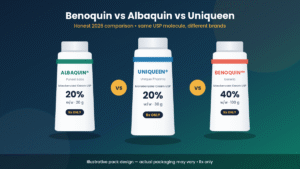
Benoquin vs Albaquin vs Uniqueen — Honest 2026 Comparison
Benoquin vs Albaquin vs Uniqueen — Honest 2026 Comparison One thing to know first. All three are brand…
Read article →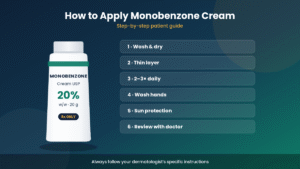
How to Apply Monobenzone Cream — Step-by-Step Patient Guide
How to Apply Monobenzone Cream — Step-by-Step Patient Guide Always follow your dermatologist’s specific instructions. This guide is…
Read article →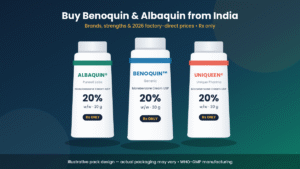
Buy Benoquin & Albaquin Monobenzone Cream from India (Rx Only) — Brands, Strengths & 2026 Prices
Buy Benoquin & Albaquin Monobenzone Cream from India (Rx Only) — Brands, Strengths & 2026 Prices Important. Monobenzone…
Read article →