
Depigmentation Therapy for Vitiligo: Complete 2026 Guide to Monobenzone Cream
A note on this page. This is an educational guide reviewed by a registered dermatologist. It does not replace consultation with your own physician. Monobenzone is a prescription-only medication; the treatment described here causes permanent, irreversible loss of skin pigmentation and is suitable only for a narrow group of patients.
When most of a person’s skin has already lost its pigment to vitiligo, the conventional treatment goal — repigment what’s been lost — becomes impractical. There simply isn’t enough remaining melanocyte function to restore an even tone across the body. At that point, dermatologists may consider the inverse approach: depigmenting the small areas of normally-pigmented skin that remain, so the entire body matches.
This is depigmentation therapy. The medication that makes it possible is monobenzone, and it is the only US-FDA-approved treatment for this indication. This guide explains what monobenzone is, how it works, who is and is not a candidate, the realistic timeline and side-effects profile, and why the supply landscape changed after the Benoquin brand was discontinued in the United States.
What is depigmentation therapy?
Depigmentation therapy is a topical treatment that permanently removes the remaining melanin from the skin of patients with extensive vitiligo. It is the conceptual opposite of repigmentation therapy (phototherapy, calcineurin inhibitors, JAK inhibitors, surgical melanocyte transplantation), all of which try to restore pigment to depigmented patches.
The therapy was first described in the 1950s and has been clinically refined since. The principal active agent is monobenzone, also known as monobenzyl ether of hydroquinone (MBEH). It is applied topically over a course of 6 to 12 months and produces a uniform, depigmented skin tone across the treated areas.
The Global Vitiligo Foundation and DermNet NZ both describe depigmentation as appropriate for patients with treatment-resistant vitiligo affecting more than 50% of body surface area, or for those whose vitiligo is highly visible on the face and hands and has not responded to repigmentation efforts.
What is monobenzone?
Monobenzone is the common name for monobenzyl ether of hydroquinone (MBEH), a topical depigmenting agent. Chemically, it is the benzyl ether derivative of hydroquinone. Clinically, it is distinct from hydroquinone — see our monobenzone vs hydroquinone comparison for why these are not interchangeable.
It became commercially available in the United States under the brand name Benoquin, manufactured first by ICN Pharmaceuticals and later by Valeant Pharmaceuticals. Although Valeant voluntarily discontinued the Benoquin brand around 2008 for commercial (not safety) reasons, the active ingredient monobenzone remained on the FDA’s approved drug list. Today, US patients obtain it through compounding pharmacies or by importing internationally-manufactured monobenzone with a prescription. For the discontinuation story in detail, see Benoquin Cream Discontinued in the US — What Happened.
In India, monobenzone is manufactured at WHO-GMP-certified plants under several brand names — Albaquin (Puneet Labs), Uniqueen (Unique Pharma), and a number of generic Benoquin formulations including the one EL.V. Life Sciences supplies.
How does monobenzone work?
The current scientific understanding is that monobenzone causes selective, cytotoxic destruction of melanocytes — the cells in the epidermis that produce the pigment melanin. The mechanism involves:
- Conversion in the cell. Monobenzone is taken up by melanocytes, where the enzyme tyrosinase oxidises it into reactive quinone metabolites.
- Oxidative stress within the melanocyte. Those metabolites generate reactive oxygen species and bind to proteins inside the melanocyte, including melanosomal proteins.
- Immune activation. The damaged proteins are presented to the immune system, which recognises them as foreign and mounts a CD8+ T-cell response.
- Melanocyte destruction. The combined oxidative and immune attack kills the melanocyte. Once melanocytes are gone, the skin loses its ability to make melanin in that area — permanently, in almost all cases.
The newest research, summarised in a recent paper in Dermatology Times and a 2024 study in PMC, has explored whether the systemic oxidative-stress effects extend beyond the skin. The findings are early but worth knowing about — your dermatologist can discuss them in the context of your case.
Who is depigmentation therapy for?
The medical criteria for depigmentation are deliberately strict. This is irreversible therapy that fundamentally and permanently changes a person’s appearance. The standard candidate profile, as described by DermNet NZ and the Global Vitiligo Foundation, is:
- A confirmed diagnosis of vitiligo (idiopathic, segmental or non-segmental forms)
- Extensive involvement — typically more than 50% of body surface area — or extensive involvement of cosmetically prominent sites (face, hands) that have failed repigmentation therapy
- The patient has been informed about the permanent, irreversible nature of the depigmentation
- The patient understands the lifelong sun-protection requirement after treatment
- The patient has been counselled about the psychological, social and cultural implications of a permanent change in skin tone
- No active uncontrolled skin disease at the treatment site
Stable, segmental vitiligo affecting less than 50% BSA is not an indication for depigmentation — for those patients, repigmentation remains the goal.
Who should NOT use monobenzone
This list is just as important as the candidate list:
- Anyone seeking general skin lightening or cosmetic skin whitening. Monobenzone is not a cosmetic product and will cause permanent damage.
- Patients with vitiligo affecting less than 50% BSA, unless explicitly recommended by a dermatologist for facial/hand involvement that has failed other treatments.
- Anyone without a confirmed vitiligo diagnosis.
- Patients who have not had a frank conversation with their dermatologist about the permanence of the outcome.
- Pregnant or breastfeeding women, unless specifically advised by their physician.
- Children, unless under specialist supervision in a clinical setting.
If anyone — including a relative, a friend, an unscrupulous “skin clinic” or an unverified online seller — offers you monobenzone for cosmetic skin lightening, refuse. The medication is real and powerful, and misuse causes irreversible harm including “satellite depigmentation” in areas you didn’t intend to treat.
How monobenzone is applied
The standard 20% strength is applied to areas of normally-pigmented skin (not the depigmented vitiligo patches — those are already pigment-free).
The typical protocol — confirmed by the Benoquin prescribing information and clinical case series including this 2013 PMC paper — is:
- A thin layer rubbed into the normally-pigmented area two to three times daily
- Treatment usually starts on a small area (often the face or arms) for the first 3 to 4 months, so skin response can be assessed before expanding
- Once a treated area has fully depigmented, treatment moves on to the next area
- Once all desired areas are depigmented, maintenance is two applications per week, ongoing
A 40% strength variant exists as an off-label option for cases where 20% has not produced adequate response — see our 20% vs 40% guide.
Realistic results timeline
Patients who are evaluating monobenzone need a realistic mental model of how slow the process is. Skipping this section is the most common source of frustration later.
| Period | What’s happening | What you’ll see |
|---|---|---|
| Month 0–2 | Cellular changes are starting; melanocyte attack is underway. | Little or no visible difference. Don’t conclude the treatment isn’t working. |
| Month 2–4 | First melanocytes are dying off; melanin production slows. | First visible lightening of treated areas, especially face and arms. |
| Month 4–9 | The dominant period of visible change. | Treated areas progressively match the depigmented vitiligo patches. |
| Month 9–12 | Full depigmentation of most treated areas. | An even, uniform skin tone across treated regions. Hands and feet may lag and need additional months. |
A widely-cited PMC case study documented successful depigmentation in 3.5 months on twice-daily 20% application, with results stable at 3-year follow-up. That’s a fast responder — most patients are closer to 9–12 months.
Side effects and long-term considerations
The common, expected side effects are:
- Burning or stinging on application
- Skin irritation, dryness, flaking of treated areas
- Erythema (redness) in the first weeks
These are dose-dependent and usually settle as treatment continues.
The more important risks to know about and discuss with your dermatologist:
- Satellite depigmentation. Patches of depigmentation can appear at sites distant from the application area. This is an immune-mediated effect, not topical spread.
- “Consort vitiligo.” Documented cases exist of skin-contact partners of patients on monobenzone developing depigmentation of their own. Hand-washing after application and avoiding skin contact while the cream is wet are sensible precautions.
- Lifelong UV sensitivity. Skin without melanocytes is permanently more vulnerable to sunburn, photoaging and skin cancer. Daily broad-spectrum SPF 50+ sunscreen on all treated areas is non-negotiable for life. See our sun-protection guide.
- Systemic effects. A 2024 PMC study and a Dermatology Times summary have raised questions about whether monobenzone-induced oxidative stress has effects beyond the skin. The clinical significance is not yet settled, but it is a live area of research worth discussing with your physician.
- Psychological and social impact. A permanent, visible change in skin tone is a significant life event. Many vitiligo specialists recommend pre-treatment counselling, particularly for patients of colour or in cultural contexts where skin tone carries strong social meaning.
Permanence — what “irreversible” really means
Monobenzone-induced depigmentation is, in almost all clinical cases, permanent. Unlike vitiligo itself, which can spontaneously repigment in some cases, areas treated with monobenzone are unlikely ever to recover melanin.
For most patients, that’s the point of the therapy — uniform, stable skin tone after years of patchy disease. But it is also the reason the candidate criteria are strict and the counselling step is non-negotiable. There is no “undo.” The decision to proceed should be made with full information, ideally over multiple consultations.
Why Benoquin disappeared in the US — and where the drug is still made
Benoquin 20% was the original FDA-approved brand, manufactured by ICN Pharmaceuticals and inherited by Valeant when ICN was acquired. Around 2008, Valeant voluntarily discontinued the brand. The withdrawal was a commercial decision — depigmentation therapy is a small specialist market — not a safety action.
The FDA did not withdraw the approval of the active ingredient monobenzone. It remains an approved drug. US patients today obtain it through:
- Compounding pharmacies in the US that produce monobenzone formulations on prescription, typically $80–$200+ per tube
- International personal importation under the FDA’s personal-importation policy, most commonly from Indian manufacturers
The full Benoquin discontinuation story — and its implications for patients — is in Benoquin Cream Discontinued in the US.
Global availability today
Outside the United States, monobenzone is manufactured at scale in India and supplied to most countries that permit it for vitiligo depigmentation. Indian brands include:
- Albaquin (Puneet Laboratories, Mumbai) — 20%
- Uniqueen (Unique Pharma & International, Mehsana) — 20% micronized, and a 40% Uniqueen Plus variant
- Generic Benoquin — multiple GMP-certified manufacturers including EL.V. Life Sciences
European patients sometimes source compounded monobenzone through specialist pharmacies in their own country; availability varies sharply by jurisdiction. For UK, EU, MEA and SE Asia patients, importing under personal-use rules is often the most reliable route. See our import guides for country-specific details.
Frequently asked questions
Is monobenzone FDA-approved? Yes. The active ingredient is FDA-approved for final depigmentation in extensive vitiligo. The original Benoquin brand was discontinued by Valeant around 2008 — but the approval of the drug itself remains in effect. See Is monobenzone FDA-approved in 2026? for the regulatory detail.
Does it work on small vitiligo patches? No — and that’s not what it’s for. Small patches should be treated with repigmentation therapies (phototherapy, topical calcineurin inhibitors, JAK inhibitors). Monobenzone is the treatment of last resort for extensive disease.
Can it be reversed if I change my mind? Effectively no. Once melanocytes are destroyed, they don’t regenerate. There are isolated case reports of partial repigmentation but they are exceptions. Treat it as permanent when making the decision.
Is it the same as hydroquinone? No. Hydroquinone is used as a temporary skin-lightening agent (and is itself heavily regulated in many countries). Monobenzone is the benzyl ether of hydroquinone, behaves very differently in melanocytes, and produces permanent depigmentation rather than temporary lightening. See Monobenzone vs Hydroquinone.
What’s the difference between Benoquin, Albaquin and Uniqueen? They are all brand names for monobenzone cream, made by different manufacturers. Clinically equivalent at the same concentration. See Benoquin vs Albaquin vs Uniqueen.
Can I order Indian monobenzone with a US, UK or EU prescription? Yes, for personal use, in line with each country’s personal-importation rules. See our FDA personal-importation guide and UK/EU/MEA import guide.
If you’ve already been prescribed monobenzone
If your dermatologist has recommended monobenzone and you’re working out how to source it affordably and reliably, EL.V. Life Sciences supplies Albaquin, Uniqueen and our own generic Benoquin direct from a WHO-GMP plant in India — against a valid prescription. See brands and indicative prices or send your Rx on WhatsApp.
Sources
- DermNet NZ — Depigmentation therapy for vitiligo
- Global Vitiligo Foundation — Depigmentation
- Drugs.com — Benoquin prescribing information
- PMC — Successful Treatment of Extensive Vitiligo with Monobenzone
- PMC — Effect of Monobenzone on Oxidative Stress in Vitiligo Patients (2024)
- Dermatology Times — Monobenzone and Oxidative Stress
- ScienceDirect — Monobenzone overview
- FDA — Personal Importation Policy
Medically reviewed by Dr Vandana Singh, MD Dermatology · Last updated 29 May 2026
You might also like
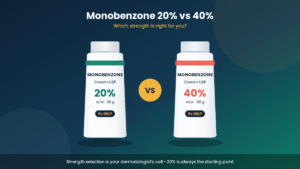
Monobenzone 20% vs 40% — Which Strength Should You Choose?
Monobenzone 20% vs 40% — Which Strength Should You Choose? Strength selection is a dermatologist’s call, not a…
Read article →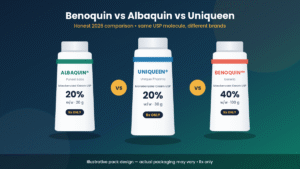
Benoquin vs Albaquin vs Uniqueen — Honest 2026 Comparison
Benoquin vs Albaquin vs Uniqueen — Honest 2026 Comparison One thing to know first. All three are brand…
Read article →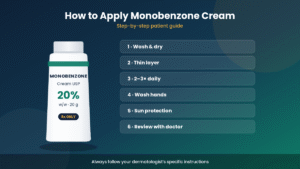
How to Apply Monobenzone Cream — Step-by-Step Patient Guide
How to Apply Monobenzone Cream — Step-by-Step Patient Guide Always follow your dermatologist’s specific instructions. This guide is…
Read article →