
Benoquin Cream Discontinued in the US — Why It Happened & How Patients Get Monobenzone Today
Quick answer. Benoquin, the only US-FDA-approved brand-name monobenzone cream, was voluntarily discontinued by its manufacturer (Valeant Pharmaceuticals, formerly ICN) around 2008. The discontinuation was a commercial decision, not a safety action. The active ingredient — monobenzone — remains FDA-approved and is still manufactured at scale internationally, particularly in India. US patients obtain it today through compounding pharmacies or, more commonly, by importing it for personal use with a valid prescription under the FDA’s personal-importation policy.
If you’ve been hunting for Benoquin and finding only confused answers, this article is for you. We’ll walk through what Benoquin was, why it vanished from US shelves, what filled the gap, and how patients with extensive vitiligo are sourcing monobenzone today — including the regulatory framework that makes personal import legal.
This is one of the most-asked questions in the vitiligo community, and the answers floating around online are often half-right. Here is the full picture, as of 2026.
What Benoquin actually was
Benoquin was the brand name for monobenzone cream — specifically, monobenzyl ether of hydroquinone (MBEH) 20% in a topical cream base. It was the only US-FDA-approved depigmentation therapy for patients with extensive, treatment-resistant vitiligo affecting more than 50% of body surface area.
It was originally developed and marketed by ICN Pharmaceuticals. When ICN was reorganised into Valeant Pharmaceuticals International in 2003, Benoquin came along with the rest of ICN’s dermatology portfolio.
For roughly five decades, Benoquin was the medication that made universal depigmentation a viable clinical option. It is the same medication that, by all reputable medical accounts, Michael Jackson used under medical supervision as he managed extensive idiopathic vitiligo confirmed at autopsy.
Why it was discontinued
The short version: commercial reasons, not safety.
Vitiligo affects roughly 0.5% to 2% of the global population. Of those, only a minority have disease severe enough — generally >50% BSA — to be candidates for depigmentation therapy. The total addressable market for Benoquin in the United States is small, niche, and slow-moving. Patients use the drug for 6 to 12 months, then drop down to a small maintenance dose. There’s no large chronic-use base.
When Valeant inherited the ICN dermatology portfolio, it began a multi-year process of rationalising slow-moving products. Benoquin was discontinued around 2008. There was no recall. There were no safety concerns flagged by the FDA. There was simply no commercial reason for Valeant to keep manufacturing it at the scale required.
This pattern — small-market drugs quietly disappearing as their owners consolidate — is a well-documented theme in US pharmaceutical regulation. Drugs.com still hosts the Benoquin prescribing information and explicitly notes the brand has been discontinued.
What did NOT happen
Three things people commonly assume — and three corrections worth making explicit:
- The FDA did not withdraw monobenzone’s approval. The active ingredient remains on the FDA’s approved list. The discontinuation was a manufacturer decision, not a regulator decision.
- Monobenzone was not banned for safety reasons. No safety signal triggered the withdrawal. The drug’s known side-effects profile (irritation, satellite depigmentation, lifelong UV sensitivity) was known before 2008 and continues to be known now.
- Monobenzone is not unavailable globally. Production simply moved. India, in particular, never stopped manufacturing monobenzone at scale, and the molecule is widely supplied in markets where vitiligo depigmentation is recognised as a legitimate therapy.
What changed for US patients after 2008
For roughly a year after the discontinuation, patients were caught short. Several reported difficulty finding any source of monobenzone at all. Then the supply chain rerouted itself in two directions:
1. Compounding pharmacies. A handful of US-based specialty compounding pharmacies — including CareFirst Specialty Pharmacy, CFS Pharmacy, and a number of regional players — began producing monobenzone in-house from USP-grade active pharmaceutical ingredient. They dispense it on prescription, just as Benoquin was dispensed. The compounded versions are clinically equivalent to the original Benoquin.
The downsides are price and consistency. Compounded monobenzone in the United States typically runs $80 to $200 per 30 g tube, depending on the pharmacy. Insurance coverage for depigmentation is sparse — most patients pay out-of-pocket. Supply is also intermittent; some pharmacies stock it routinely, others compound to order with weeks of lead time.
2. International personal importation. US patients with a prescription have, since the early 2010s, increasingly imported monobenzone manufactured overseas. India is the dominant source. The FDA has a long-standing personal-importation policy that explicitly accommodates this kind of situation:
“FDA’s personal importation policy provides guidance regarding situations where FDA does not intend to prevent the importation of an unapproved drug for personal use.”
The qualifying criteria are:
- The drug is for treatment of a serious condition (extensive vitiligo qualifies)
- The drug is not commercially promoted to US consumers
- The drug does not represent an unreasonable risk
- The patient affirms in writing that it is for personal use
- The quantity is generally not more than about a 90-day supply
- Either the name and address of a US-licensed physician is provided, or there is evidence the treatment was begun outside the US
Monobenzone for diagnosed extensive vitiligo fits neatly into that framework. The article on FDA personal importation for monobenzone walks through the documentation in detail.
Where monobenzone is manufactured at scale today
India is the dominant global source. Three companies are particularly visible:
- Puneet Laboratories (Mumbai) — manufactures the Albaquin brand at 20%. Widely exported and available through Indian retail pharmacies including Apollo and 1mg, which makes the brand easy to verify.
- Unique Pharma & International (Mehsana, Gujarat) — manufactures the Uniqueen brand at 20% (in a micronized formulation) and Uniqueen Plus / Benoquin 40% at the higher strength. Established 2013, exporting to Saudi Arabia, Iraq, Oman, Kuwait, Libya among others.
- EL.V. Life Sciences and other GMP-certified manufacturers — produce generic Benoquin 20% formulations from WHO-GMP plants in Baddi, Himachal Pradesh, against USP specifications.
All three lines use monobenzone USP — the same active ingredient that was in the original Valeant Benoquin. From a pharmacological standpoint, there is no clinical difference at equal concentrations.
The Indian pricing reality
This is the part that often surprises US and UK patients. A 20 g tube of Albaquin manufactured in Mumbai sells in India for roughly ₹348 (about $4) at retail. Manufacturer-direct, the price band for international orders is approximately $5 to $8 per tube.
For comparison, US compounded monobenzone — which contains the identical active ingredient — is in the $80 to $200 per tube range.
The price difference is structural. Indian pharmaceutical manufacturing operates at scale on raw-material costs, regulatory frameworks and labour rates that produce dramatically lower per-unit costs than US compounding. The active ingredient is the same. The depigmenting effect is the same. The price is roughly 1/20 to 1/40.
For patients on lifelong maintenance (after the initial 6–12 month treatment course, ongoing application twice weekly), the cumulative cost difference becomes substantial.
The Michael Jackson reference
Almost every conversation about monobenzone touches on Michael Jackson eventually. The medical facts are these: Jackson was diagnosed with idiopathic vitiligo, and autopsy examination confirmed both the diagnosis and the loss of melanocytes in his skin. The University of Massachusetts Vitiligo Clinic & Research Center reported that Benoquin was among his medications. Under medical supervision, he used the only FDA-approved treatment available for the condition he had — extensive vitiligo no longer realistically treatable by repigmentation.
For an extended discussion of the facts and the myths, see Michael Jackson & Monobenzone — Separating Myth from Medical Fact.
The reason this matters here is straightforward: when patients learn that the medication Jackson reportedly used has been quietly discontinued in the US for two decades, the question becomes practical — how do we still get it. The answer is the one this article has been building to: through prescription, through a legitimate manufacturer, ideally direct from a WHO-GMP plant in India.
How to actually source monobenzone today — step by step
- Get a prescription from your dermatologist. This is non-negotiable, regardless of where you source the drug. Your dermatologist should confirm you meet the candidate criteria (extensive vitiligo, irreversibility understood, sun-protection plan in place) and write a standard prescription for monobenzone 20% (or 40%, if appropriate).
- Decide between US compounding and international personal importation. US compounding is fast and US-regulated but expensive. International import is slower, requires customs comfort, but is approximately one-twentieth the price. For patients on long-term maintenance, the import route often makes more sense after the first treatment phase.
- If importing, choose a verified manufacturer or supplier. Not all Indian online sellers are legitimate. Look for WHO-GMP or ISO 9001 certification, a willingness to provide Certificate of Analysis (COA) with each shipment, a real physical address, and a clear prescription requirement. If a seller will ship monobenzone without asking for an Rx, that is a red flag, not a convenience.
- Upload your prescription. A reputable supplier will ask for the Rx before quoting and shipping. We accept Rx images, PDFs and faxed documents.
- Confirm the order and pay. Bank wire and Wise are the most common payment methods for international orders.
- Receive the shipment with documentation. A legitimate shipment includes COA, commercial invoice, and a prescription cover letter — these are the documents customs may ask for.
Risks of buying from random online sellers
A non-trivial fraction of the websites that come up when you Google “buy Benoquin” are unverified and, in some cases, outright counterfeit operations. The risks include:
- Counterfeit product — wrong active ingredient, wrong concentration, or no active ingredient at all
- No COA — so no way to verify what’s in the tube
- Customs seizure — generic shipments without paperwork are more likely to be held
- Lost payment — some sellers take the money and never ship
- No after-sales support — when irritation or unexpected response happens, there’s no one to talk to
The signal-to-noise ratio is high enough that it’s worth doing 15 minutes of due diligence before ordering. The questions to ask a prospective supplier:
- Are you WHO-GMP / ISO 9001 certified?
- Will you provide COA for the specific batch I receive?
- Will you ship without a prescription? (The right answer is no.)
- What is your physical manufacturing address?
- Do you have export experience to my country?
EL.V. Life Sciences manufactures generic Benoquin at a WHO-GMP plant in Baddi, has 15 years in PCD pharma and exports to over 10 countries. We dispatch monobenzone only against a valid prescription. See brands and prices →
Frequently asked questions
Is Benoquin coming back to the US market? There is no public signal that any manufacturer plans to relaunch a branded Benoquin product in the US. The economic case has not changed since 2008. Patients should plan around compounded supply or personal importation.
Is monobenzone safe? It has a well-documented side-effects profile: skin irritation, satellite depigmentation, lifelong UV sensitivity of treated skin, and — more recently — emerging research on systemic oxidative stress. It is appropriate for a narrow clinical population (extensive vitiligo) under dermatologist supervision. It is not safe for cosmetic use. See our side-effects guide.
Will US customs hold a personal-use monobenzone shipment? Not commonly, when the documentation is in order. Holds become more likely when shipments arrive without prescription paperwork, when quantities exceed roughly a 90-day supply, or when shipments come from sellers who don’t supply the required customs documents. The FDA personal-importation policy describes the framework.
Do Indian brands really have the same active ingredient as Benoquin? Yes. Albaquin, Uniqueen, and the various generic Benoquin formulations all use monobenzone USP — the United States Pharmacopeia grade, same standard as the original Benoquin. Excipient bases differ slightly but the depigmenting molecule is identical.
Is the 40% strength legal for me to import? The 40% strength is off-label and stronger than the FDA-approved 20%. Personal-importation rules are about the indication and quantity, not specifically the concentration. If your dermatologist has prescribed 40%, the import is reasonable; we do not supply 40% without an Rx that names it specifically.
What if I started treatment in another country? The FDA personal-importation policy explicitly accommodates continuation of treatment begun outside the US. Documentation showing the original treatment was started overseas strengthens an import request.
What to do if you’ve been prescribed monobenzone
If your dermatologist has recommended monobenzone and you’re working through whether to use US compounding or import from India, the practical comparison is in our buying guide. For the regulatory mechanics, see our FDA personal-importation guide.
EL.V. Life Sciences supplies Albaquin, Uniqueen and generic Benoquin from a WHO-GMP plant in India against valid prescriptions. Send your Rx on WhatsApp → or open the order form.
Sources
- Drugs.com — Benoquin prescribing information
- SkinSafe — Benoquin Cream (Valeant/ICN) profile
- FDA — Personal Importation Policy
- University of Massachusetts Vitiligo Clinic — Did Michael Jackson have vitiligo?
- Puneet Laboratories — Albaquin product page
- Unique Pharma & International — Uniqueen Monobenzone Cream
- DermNet NZ — Depigmentation therapy for vitiligo
Medically reviewed by Dr Vandana Singh, MD Dermatology · Last updated 29 May 2026
You might also like
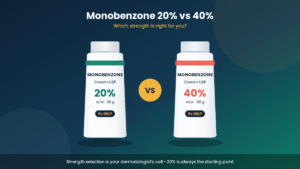
Monobenzone 20% vs 40% — Which Strength Should You Choose?
Monobenzone 20% vs 40% — Which Strength Should You Choose? Strength selection is a dermatologist’s call, not a…
Read article →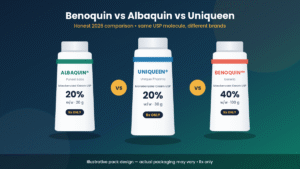
Benoquin vs Albaquin vs Uniqueen — Honest 2026 Comparison
Benoquin vs Albaquin vs Uniqueen — Honest 2026 Comparison One thing to know first. All three are brand…
Read article →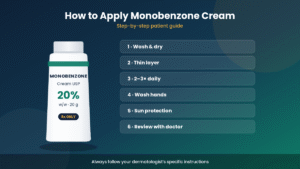
How to Apply Monobenzone Cream — Step-by-Step Patient Guide
How to Apply Monobenzone Cream — Step-by-Step Patient Guide Always follow your dermatologist’s specific instructions. This guide is…
Read article →